

This piece is an op-ed by a Venezuelan journalist that has worked closely with Maria Corina Machado. They are writing under a pen name so as not to damage the reputation of their employer. You can find their Substack, where the piece is cross-published, here.
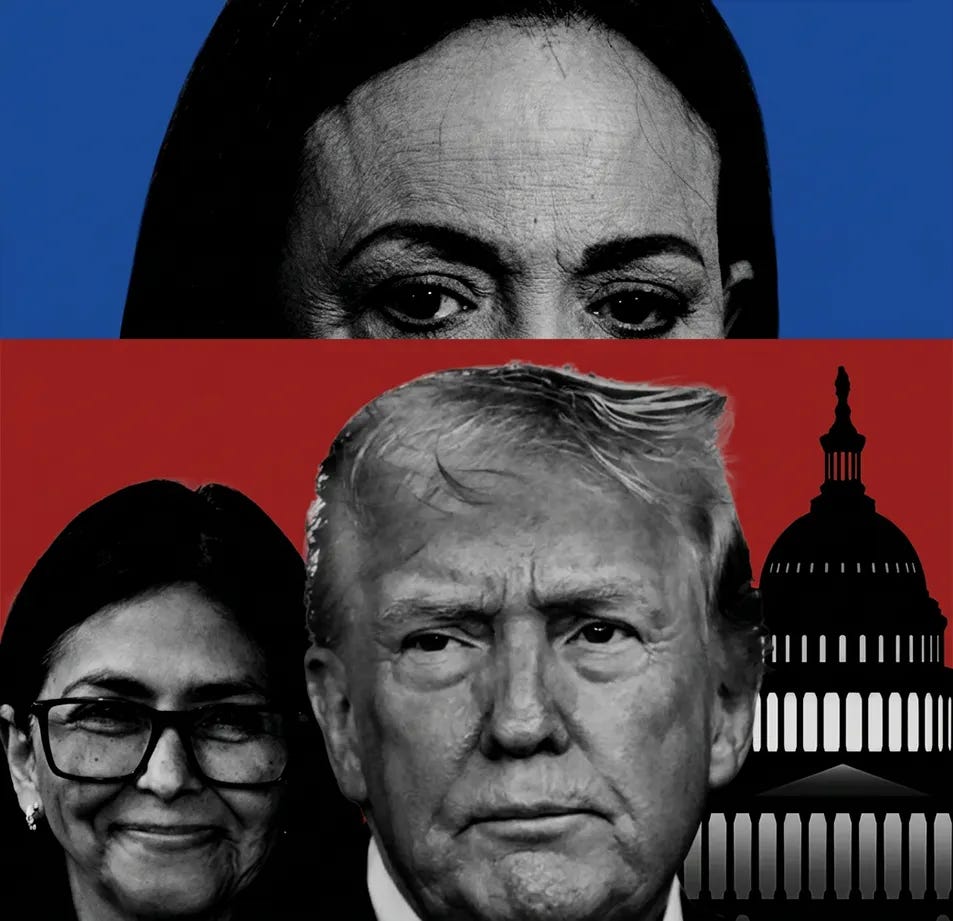
A new agreement between the United States and Venezuela gives Washington majority control over more than 65 billion barrels of Venezuelan reserves. Some Venezuelans and analysts have called it “theft without a gun.” The deal has been praised by interim president Delcy Rodríguez and US Secretary of State Marco Rubio alike. Unsurprisingly, Venezuelan opposition leader María Corina Machado, who has been sidelined by US President Donald Trump in recent months, was absent from the announcements and victory laps.
Frustration and anger is growing in Venezuela over Washington’s decision to keep the Chavista regime intact. But the writing that Machado wouldn’t pass muster with DC was on the wall long before the Delta Force invaded Caracas and captured Nicolás Maduro.
In 2024, I took meetings with senior members of Vente Venezuela, Machado’s political party, about content creation and advocacy here in America. I raised what seemed to me an obvious concern: the political landscape in the US was shifting and Vente needed bipartisan outreach, stronger media relationships, and professional DC representation capable of surviving partisan control shakeups caused by midterms and presidential elections.
The suggestions were quickly rebuffed. “We have Rick Scott and Marco Rubio,” they said over and over. The comments reflected a naive belief that political access would translate to political influence.
They seemed to believe that Trump, via influence through Rubio and the Florida political machine, would simply install them in power.
In some ways, the arrogance was understandable. For a time their interests had aligned with the mercurial Trump. In 2019 his administration courted them. And Rubio seemed a powerful ally, who shared their desire to topple Maduro.
But they made a miscalculation about Trump that many former allies have made before: Trump cares only about Trump’s interests, and has no ideology beyond what immediately benefits him.
One of the Vente representatives I spoke with on those first calls is an ardent Trump supporter who also works for an immigration services firm. As Venezuelans in the US faced deportation threats, I watched him promote Vente, Trump, and his immigration business simultaneously. Inherent contradictions aside, his attitude speaks to a larger problem. At precisely the moment when Venezuelans needed political leverage in Washington, opposition emphasis remained obsessed with political allegiance.
The real question was never whether one supported Trump. The question was whether one possessed enough influence to protect Venezuelans when Trump’s priorities diverged from Vente’s.
During another call that same year, a different senior coordinator asked me for money. The request didn’t bother me in principle. After all, presidential campaigns cannot run on enthusiasm alone. What concerned me was the lack of structure and accountability. Would any arrangement be authorized by MCM herself or by this supposed handler? I later mentioned the exchange to a trusted contact, and I was told it was probably a misunderstanding.
Weeks later, another call was arranged, this time with my producing partner on the line. Earlier conversations suggested meaningful access to Machado and filming opportunities, but during this call those bright possibilities were abruptly unplugged.
The coordinator then asked whether promotional support could be provided by our team, free of charge. The operation, for lack of a better term, seemed to run on favors and personal understandings rather than any defined structure or protocols.
Perhaps the opposition’s biggest mistake was misreading its role. After decades of corruption under Chavismo and failures by traditional opposition parties, Vente saw itself as la última Coca-Cola en el desierto, “the last Coca-Cola in the desert.”
But somehow, they confused their own perceived legitimacy with destiny, and their followers grew drunk on the mixture. There was only one problem: you’re not supposed to get drunk on Coca-Cola.
Politics punishes movements that confuse a mandate with inevitability. A movement that becomes convinced it has been chosen by history stops asking itself uncomfortable questions.
In January, Trump showed by his actions that Vente was not the only option. It turns out he didn’t even consider it a serious option. Maduro’s capture and Delcy’s elevation to head of state put Vente’s perceived destiny in the trunk of a car riding out to the desert with the hole already dug.
No more Coca-Cola.
What ultimately changed my thinking about Machado’s prospects were her first major clandestine interviews after the 2024 election — widely viewed as fraudulent domestically and by the international community.
I helped connect a leading American news program with her team, coordinated communications, and even offered contingency options in the event of any power outages or connectivity problems inside Venezuela. What followed was telling: communication became increasingly centralized, my involvement disappeared from the narrative, and questions I raised about this process were met with suspicion, accusation, and contempt by their communications rep.
My experience was hardly unique. I’ve spoken with journalists and producers from various media outlets who described similar experiences with Vente and Machado’s media operation. Details varied subtly, but the pattern was always the same: initial contact, then enthusiasm about the media request, followed by concerns about the outlets’ prior reporting, and then silence.
Some have gone as far as to call Vente’s coordinators liars who continually misled reporters. A quote from a senior producer dealing with Vente put it best: “If this is how they handle interviews, how in the world will they govern?”
For a movement seeking to lead a democratic transition, these are warning signs: criticism becomes betrayal, questions become obstacles, then independent actors become threats. Loyalty became a currency more important than competence.
I first met Machado when she was a member of the National Assembly; she was warm, gracious, and very clear about her thoughts and feelings for Venezuela’s future.
I was struck by watching her among ordinary Venezuelans in remote inlets far from Caracas. People emerged from humble homes by the thousands to embrace her because they believed she represented real change. She was caring towards everyone, including me.
She is, in some ways, a living symbol of Western democracy, a Nobel laureate carrying the hopes of a nation exhausted by authoritarianism, and her popularity within Venezuela remains unmatched by any other political figure.
So why does a movement built around such an admired democratic figure subject itself to such institutional weakness. Perhaps more curious, why the open hostility to scrutiny? To the extent she knows about the events described here, I cannot say. Perhaps Machado doesn’t know. Or maybe she lacks control over parts of her own organization.
A movement capable of governing a country should be capable of governing itself.
Would a DC lobby have changed Trump’s decisions? I don’t know. But Vente never bothered to find out. Instead of serious engagement in the capital on sanctions, immigration, and energy policy, Vente relied solely on symbolic access, leaving Venezuelans without strong advocates and Machado without influence. Influence, like democracy, requires constant vigilance.
Recently, I raised my concerns again to one of the operatives I first spoke with in 2024. They responded with vulgarities and hostility before repeating the same line: “Are you suggesting Rick Scott and Marco Rubio aren’t relevant?”
The operative seemed unaware that the context of her own organization had changed just a month before. In July, Machado’s team formally retained the BGR Group for all political and PR affairs in DC.
MCM has her reasons for retaining the firm. Now she has 65 billion more. It’s an admission that the District isn’t won through symbolism. But now that Machado’s team has finally hired a DC firm, one can’t help but wonder whether, on the firm’s intake forms, they listed Rick Scott or Marco Rubio as their primary reference.
You can also donate a one-time gift via “Buy Me a Coffee”. It only takes a few moments, and you can do so here.
And if you can’t do any of that, please do help us by sharing the piece! We don’t have billionaire PR teams either.
Hasta pronto, piratas!

"She is, in some ways, a living symbol of Western democracy, a Nobel laureate carrying the hopes of a nation exhausted by authoritarianism, and her popularity within Venezuela remains unmatched by any other political figure." I laughed out loud reading this article.
What has MCM done to advocate for the betterment of the Venezuelan people? Has she ever denounced the genocidal US sanctions that are responsible for debilitating and killing tens of thousands of her compatriots? What about the military operation that obliterated dozens of Venezuelan people in January 2026? What kind of leverage has EVER been gained by elitist right-wingers like Lester Toledo, Leopoldo López, Juan Guaidó, Henry Ramos etc. currying favor with the US empire via fake 'populist' parties such as Acción Democrática and Primera Justicia? If Venezuela under the PDVSA is 'authoritarian,' what do you call the world's largest military superpower doing everything it can to make life miserable for the people living there?