

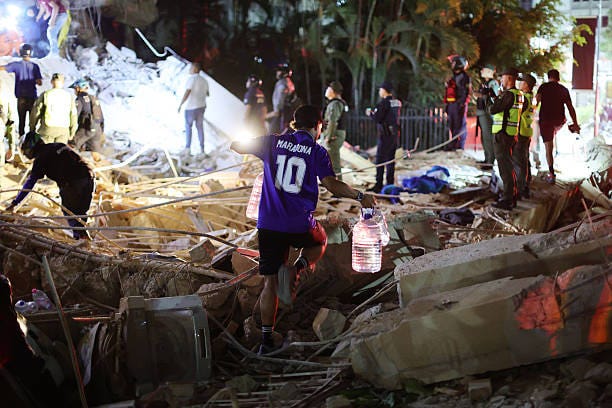
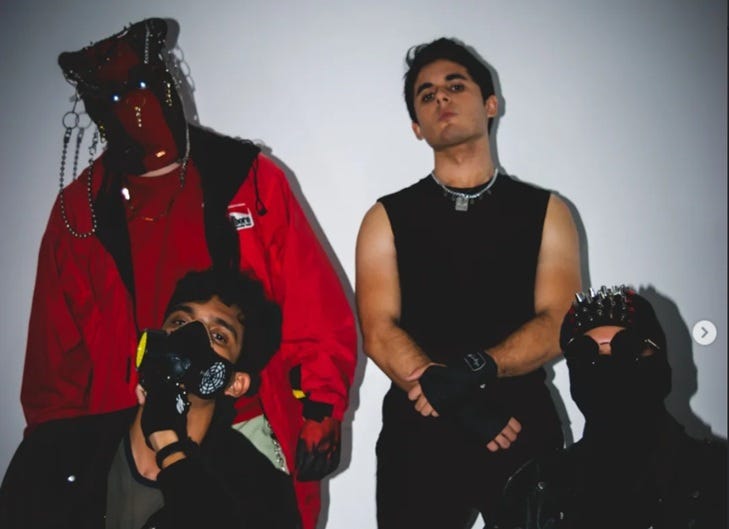
The four members of punk band “Vanderis” were rehearsing inside of a studio apartment in a multi-story building in Caracas at 6:04 p.m on Wednesday. Three of them were killed instantly when the first of two massive earthquakes struck, collapsing the building entirely.
One of them was recovered alive from the resulting rubble hours later by rescuers, but succumbed to his wounds in the hospital.
“It’s been very difficult,” Miguel Rodriguez, a Caracas resident told PWS. He said he has had “a constant pain in my stomach,” since the earthquake from the stress and anxiety. Vanderis were his friends. And they were only some of those missing on the first night after the earthquake hit, when information was in short supply, official announcements infrequent, and much of the region still suffered from internet and electricity blackouts.
More than 24 hours after two devastating earthquakes rocked coastal Venezuela — the worst tremors in more than 100 years — the first international aid began to trickle in. First from the Dominican Republic, then Ecuador. Other countries, such as Chile, Colombia, Mexico and Brazil had teams inbound.
Despite myriad statements from US officials, no rescue response had reached affected areas from the government of Donald Trump as of Thursday night, but SOUTHCOM continued to assure it was inbound.
Official government statistics now put the number of confirmed deaths at 235, but it is certainly much higher.
Wednesday was a religious holiday in Venezuela, the festivo of San Juan. It is a holiday celebrated particularly in coastal areas, and rooted in African-Venezuelan traditions honoring John the Baptist.
In fact, Miguel Rodriguez was preparing a ritual to honor San Juan in his living room when the earthquake hit. “I can’t describe the noise,” he said. “It was terrifying.” His mother, who happened to be visiting, was “frozen in place in terror. We couldn’t even flee the apartment.”
In the hours that followed, community organization played a key role in rescue and local aid coordination efforts. Though government rescue workers and firemen deployed for rescue attempts, the state struggled with rescue efforts, in some cases lacking even basic tools, such as heavy machinery to lift rubble from those trapped.
Many efforts were led and organized by the communities themselves.
With many social media platforms blocked, and a media structure stripped hollow from years of state censorship, communication at first fared little better. Basic information about road closures, which neighborhoods lacked power, and where damage was most critical was lacking.
Street journalists that operate via Whatsapp groups often helped coordinate and compilate needs and donations, getting critical food and supplies to rescue workers as well as people in need.
“Mel,” who asked that their real name not be printed, spoke with PWS as she travelled from Maracaibo to La Guaira as part of a convoy carrying food and basic first-aid supplies. They plan to volunteer in whatever manner is needed to help with the disaster response.
“There is so much bad information,” she said via phone. “We hear the highway is shut down,” to reach La Guaira. “Then 20 minutes later we confirm it is open. No one knows what’s real and what isn’t. What’s confirmed and what isn’t.”
She says some people, though they are trying to help, are inadvertently spreading false rumors that have slowed organization efforts. But her group is determined to help.
“It doesn’t matter,” she said. “We’re Venezuelans. This is how we are as a people. We’ve been through this before. The only thing that can save a community is community.”
She has little faith in state information or statistics. “We likely will never know the true number of deaths,” she said. “But that also doesn’t matter right now. We know we need to help who we can. That is all that matters.”
By all accounts, hundreds if not thousands of people remained trapped under rubble Thursday evening. The longer they stay that way, the less likely they are to survive.
You can also donate a one-time gift via “Buy Me a Coffee”. It only takes a few moments, and you can do so here.
And if you can’t do any of that, please do help us by sharing the piece! We don’t have billionaire PR teams either.
Hasta pronto, piratas!
Thank you, Josh, as if things couldn’t get any worse, eh! I just hope the E.E.U.U. steps up and helps out more.