this piece is by Colombian journalist Nicolas Zuluaga and Joshua Collins
Indigenous land defenders and environmentalists in Brazil drew a breath of relief after the victory of Luiz Inácio Lula da Silva in a dramatic presidential election.
His opponent Flavio Bolsonaro, who has now fled to Miami after calling for elections to be annulled, had promised to weaken environmental regulations and criticized programs that allow indigenous communities to protect their own lands in the Amazon basin.
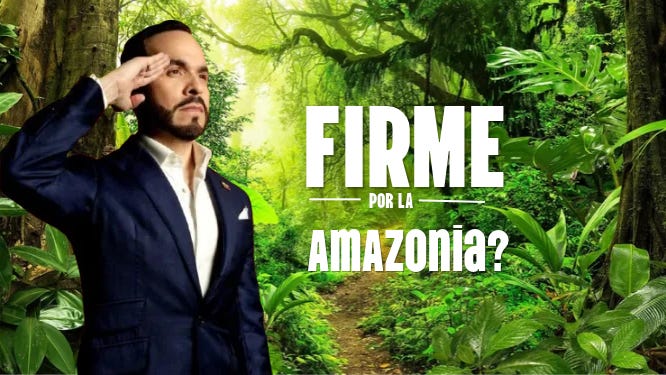
In neighboring Colombia, ultra-right wing President Abelardo de la Espriella was no doubt less thrilled about Lula’s victory— though he did offer his congratulations in a public statement.
And there are a lot of areas where their policy objectives overlap. De la Espriella’s obsession with combatting armed groups and the individuals who finance them, as well as improving security in border areas, could also help save the Amazon — if he chooses.
The two South American leaders not only share a more than 1,000-mile border (1,644 km), they also share custodianship of nearly 70% of the Amazon rainforest basin.
De la Espriella has offered to be an unlikely partner in the fight to protect that invaluable global resource. In his congratulatory message, published on social media, De La Espriella acknowledged “deep political and ideological differences” with Lula but said Brazil and Colombia “need each other.” He offered to cooperate in bilateral efforts against “narcoterrorism and illegal mining” and “the protection of the Amazon.”
In Colombia, Amazonian regions of the country have often been largely ignored by Bogota while Brazil has historically viewed them as regions to exploit for minerals and oil more than protected areas to responsibly develop and support.
In both countries, unfortunately, the Amazon has also been viewed as a place for land-grabbers to obtain acreage for commercial ranching, as well as criminals to set up illegal extortion, smuggling, mining, and logging operations.
Over the last two decades cocaine production has skyrocketed in Colombia, and the Amazonian region serves as a critical transportation hub to drug markets in Brazil and beyond.
Neither Brazil nor Colombia project much control over the dense jungle region and in recent years organized crime has increasingly moved into the vacuum.
The groups who operate there, from both countries, exert a parallel governance over the regions where they operate — a dynamic that has worsened deforestation across the all of the borderlands.
International Crisis Group, in a report from 2024 wrote:
“Emboldened by the patchy hold of state authorities on this vast area, Brazilian criminal groups have struck partnerships with Colombian guerrilla factions and Peruvian drug trafficking outfits. They exploit an array of illegal enterprises, from growing coca and processing it into cocaine to logging, dredging for gold and fishing in protected areas.”
The growth of criminality is also threatening the indigenous communities in the region who find themselves under the effective rule of criminal armed groups.
“Security in the Amazon is not possible without involving Indigenous peoples,” Bram Ebus, an Amazon researcher for the International Crisis Group, told PWS.
Indigenous communities, across South America, have a proven track-record when it comes to land custodianship. “Deforestation has been lowest where Amazon communities hold collective land tenure and govern themselves autonomously,” said Ebus.
Ebus explained that partnerships between security forces and indigenous communities work best when local populations have the autonomy and resources to monitor their own lands and can contact state forces to step in once illicit activity or violent invaders are detected.
In Colombia, however, De la Espriella seems more willing to cooperate on security than environmental protection. He has embarked on a series of “iron fist” security policies that have, so far, only increased violence as non-state armed groups step up their attacks on state forces.
Meanwhile, the flamboyant right-winger has pledged measures that would strain Indigenous governance and weaken environmental restrictions and oversight. One of Colombia’s largest indigenous political entities, the Regional Indigenous Council of Cauca, plans to join in a national strike over those policies this month.
There are plenty of places where Lula could improve things in Brazil as well: the country has often tried to combat illegal mining by sending in soldiers, who dismantle camps, publish photos to their social media pages, and then leave behind communities to deal with other problems on their own.
Ebus argues this fails to address the underlying factors that give rise to crime in the first place.
“Organized crime grows when local populations lack security, education and access to development investment,” he explained. “The crime problem cannot be solved by bombing rural areas or through military action. Military solutions are being proposed for what is a policing problem.”
Ebus also suggested tools that perhaps Lula and De la Espriella could both agree on implementing: supply chain transparency, smart enforcement against illicit financial flows and checks on who owns the companies buying illegally sourced Amazon commodities.
The Brazilian Federal Police’s clean gold project, which uses technology to trace the origin of illegally mined gold, deserves long-term support, he said. Halting strategies that reduced deforestation would be a disaster, Ebus noted, because the rainforest is already close to its tipping point —a critical threshold where severe deforestation, warming temperatures, and prolonged droughts prevent the forest from recycling its own moisture.
In simpler terms: an irreversible ecological collapse.
Criminality in the Amazon basin is deeply linked to destruction of rainforest, as both the International Crisis Group, and Amazon Underworld have often reported,
That means despite being an unlikely land-defender, De la Espriella has the chance to implement his security ambitions and save the Amazon at the same time.
There are considerable areas where his security vision overlaps with the political goals of his Brazilian counterpart. Will the two be able to overcome their ideological differences and move from trading polite messages to increased cooperation in the borderlands?
For the sake of the Amazon, the largest carbon sink in the world, and often referred to as “the lungs of the world,” we certainly hope so.

You can also donate a one-time gift via “Buy Me a Coffee”. It only takes a few moments, and you can do so here.
And if you can’t do any of that, please do help us by sharing the piece! We don’t have billionaire PR teams either.
Hasta pronto, piratas!