

This week’s feature story is by “Fausta,” a Venezuelan migrant in Florida. She is writing under a pen-name on the advice of her migration attorney.
I was getting gas. I had a list somewhere in my head—groceries, an email I had not answered. Masked ICE agents arriving in unmarked vehicles to openly conduct racial profiling in a mass sweep in my community was not on my mind as a possibility for a Tuesday morning. I was on that kind of specific American autopilot that comes from years of learning how to inhabit the ordinary rhythms of a country that has never been entirely too sure what to do with you. The pump clicked on as I looked at my phone. I was not thinking about the State. I was thinking about whether I needed to buy more coffee. The ICE vans pulled in before I finished the first gallon.
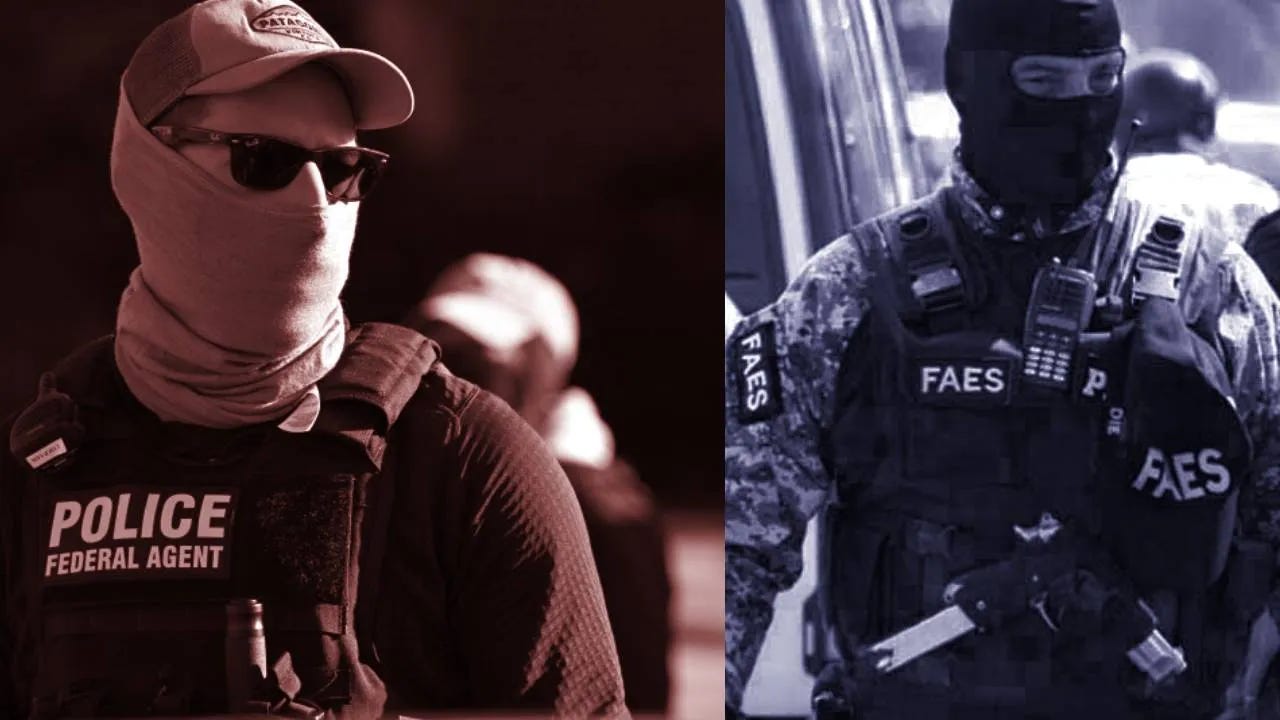
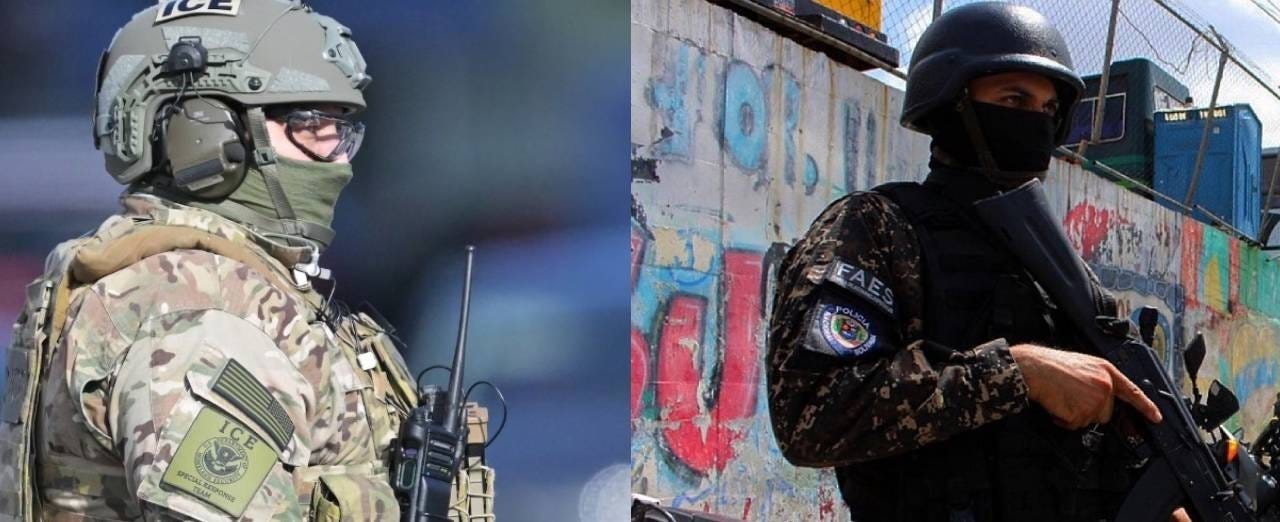
There were several vehicles, and they moved in coordination. I blame myself now for not immediately registering what was happening. Their vehicles had tinted windows, no license plates or agency markings. The men wore masks. I looked for a badge the way you look for a light switch in a dark room, automatically, because you have been told your whole life that America doesn’t use secret police. But these men were anonymous.
The absence opened something cold in my chest.
The body knows before the mind does. That is something nobody told me when I left Venezuela, but it is one of the truest things I have learned in the years since. My hands had gone cold. My body already understood what my mind was still catching up on. It had seen this before in another country under another government: the same unmarked vehicles, the same masked men.
I came to the United States from Venezuela in 2014 because I had run out of country. This is not rhetorical flourish—it is a literal description of my circumstances. Venezuela under Maduro had made the particular calculation that authoritarian states make when they decide that dissent is more dangerous than depopulation. The consequences of that calculation filtered through every layer of daily life until the life I had built there became something I could no longer safely inhabit.
I knew what masked men in unmarked vehicles meant long before I set foot on American soil.
What I had not fully reckoned with, in the years between leaving Venezuela and standing at that fuel pump, was the extent to which I had organized my sense of safety around the assumption that those signs meant something here. That the American State, whatever its contradictions, operated according to different rules than the one I had fled.
I have written about that assumption academically. I have participated in conferences that explore those ideas, assigned texts that criticize those assuptions by unmasking American exceptionalism as an ideology. And still, underneath all of that, I had believed a little that the United States truly was different than Venezuela — freer somehow, flawed, but striving towards justice.
I had let myself believe it, because the alternative—that I had exchanged one form of exposure to authoritarianism for another was not a belief I could afford to fully embrace and still get up in the morning.
The vans disabused me of that notion in the time it took them to cross the parking lot.
Michael Foucault described modern power as “panoptic”, meaning, the observed internalize surveillance because they can never be certain when the watcher is present. They become active, if unwilling, participants in the surveillance state without realizing it.
ICE agents at this Florida gas station were a physical inversion of that idea: these men were deliberately invisible, anonymous, without identity, while everyone around them stood completely exposed.
In Venezuela I had learned that this asymmetry—the State that sees everything and shows nothing—is the preferred operating condition. Terror is more terrifying when it is dispensed anonymously.
The State can do what the named, faced, accountable individual could not, because there is no self to be held to account afterward, no person at the end of the complaint, nothing to find when you go looking.
They began taking people without asking for documents. There is no need for papers when papers were never the point. The goal is the visible, public, unanswerable assertion of the state’s authority to take whoever it decides, to make that taking seem inevitable, and to do it in front of witnesses precisely because the witnesses are also the target audience of their performance.
The people being loaded into those vans had their right to an ordinary Tuesday revoked in the time it took a door to swing open. The men doing it had no names. There would be no record, and the afternoon would continue around it as if they had never existed.
What I think of most are the sexual comments the agents made about the women. I want to be plain about this because the instinct, when you write about sexual harassment in the context of something as large as what else was happening, is to treat it as secondary or an ugly accompaniment to the main event. It was not secondary. It was the same event.
They said what they said at full volume, in open air. Some of the girls looked young—too young—and the agents looked at them as if they did not look younger than fifteen. No body, I remembered my professor’s words from two weeks prior, in the operational space is outside of the enforcer’s authority.
And then one of them came to me.
He was larger than me and he put his hands on me and I felt the old cold move through my body. I was standing at a gas pump in the United States and I was also, in some cellular sense, somewhere else, some prior moment when the geometry had been similar and the outcome had been uncertain.
I can’t help but find myself giggling when I remember his reaction to my calm demeanor. How could this man understand his intimidation had no effect on me? I had seen men like him since the time I could walk.
He looked at my face and told me I had Arab looking eyebrows. The temptation at this point was to receive the racial profile as an error, embarrassing, perhaps, correctable with better training. But that his reading was wrong: I am Venezuelan and not Arab, that his threat assessment was built entirely from his own racial imagination projected onto my brow.

It is neither incidental nor accidental that he thinks this way Post-9/11 America collapsed distinctions between Arab, South Asian, Latino, and Muslim bodies into a single undifferentiated category of suspicion, and my Venezuelan face fell inside that category. The officer didn’t need me to be Arab any more than he needed to verify anyone’s papers. He needed me to look close enough to “dangerous”, and I did. That was the entirety of his legal reasoning.
He let me go because the van was full. He said it, then confirmed it with another agent standing beside him. Then he told me he would get me next time and walked away.
I stood at the pump and did not move for a very long time until I could no longer hear the screams of the taken. They shouted names and others a series of numbers, what I now recognize based on the amount, to be Social Security numbers and phone numbers. This haunts me still.
The “next time”, however, landed in a body that had already been living inside a next time for years, that had left Venezuela to escape the specific psychological condition of never knowing when the State would arrive again.
I had believed, imperfectly and necessarily, that I had left this state of psychological terror behind. Giorgio Agamben, an Italian philosopher whose work examines how States produce categories of people stripped of legal protection, described this figure as “bare life”: the figure who can be taken or released without it registering as a legal event. A Venezuelan woman at an American fuel pump,
The condition of her “freedom” is subject to revision whenever logistics change.
I wasn’t taken not due to any sense of rights or justice. It was arbitrary. I was not taken because the van ran out of room. Freedom was not a legal universal condition but a logistical accident.
There is no framework I can place around that which makes it feel like safety. There is no document, no status, no level of education or professional standing that converts it into safety. The van was full. That is the sentence at the bottom of all the other sentences.
I don’t know if he will remember my face or if I was already generic to him by the time he turned away. Another set of eyebrows close enough to dangerous, not worth the space in the van. The van was full, so I drove home, to a country I had come to think of as a refuge and that had just shown me, with thoroughness, what it thought of that arrangement.
The van was full, so I drove home.
I am writing this so that somewhere, in whatever record exists of what this country is doing in parking lots on ordinary Tuesdays, this is in it. It is ironic that this mild dissent must be anonymous as well upon the advice of my immigration lawyer.
ICE didn’t just threaten my liberty that day without reason. In a sense, they have also taken my name from me. But in a country where people have been deported for essays in University newspapers, just like in Venezuela, terror is the point.
Our very voices are taken.
You can also donate a one-time gift via “Buy Me a Coffee”. It only takes a few moments, and you can do so here.
And if you can’t do any of that, please do help us by sharing the piece! We don’t have billionaire PR teams either.
Hasta pronto, piratas!

To argue that “terror is the point” in Venezuela just like it is in the US ignores a key aspect of Venezuela’s historical development—the Venezuelan people have been under siege by US economic terrorism and hybrid warfare since the early 2000s. They have been the target of extensive CIA-backed right-wing Venezuelan regime change plots (see Juan Guaidó, Carlos Vecchio, Leopoldo López, Lester Toledo, etc). Doesn’t the fact that the US had to resort to illegally kidnapping the president in an operation that killed dozens of Venezuelan civilians serve as proof that the Bolivarian Revolution was justified?