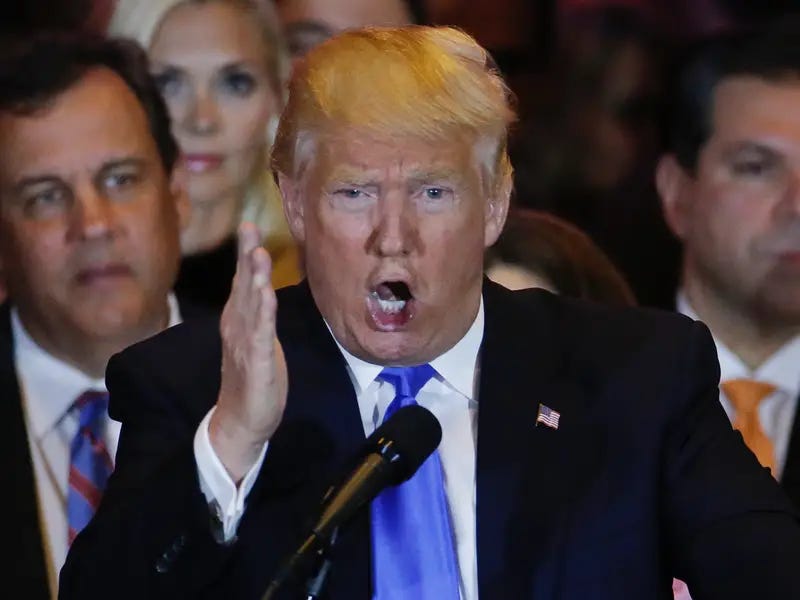
United States President Donald Trump maintained that Colombia “failed demonstrably during the previous 12 months to make substantial efforts to adhere to their obligations under international counter-narcotics agreements.”
In an annual review, Trump extended Colombia’s status as “an unreliable partner” in the ‘War on Drugs’, and stressed that the South American country maintains its an unwilling drug trafficking country “solely due to the incompetence and chaos produced by the previous far-left government.”
“If, as expected, Colombia makes progress on aggressive coca eradication and dismantling its narcoterrorist networks over the coming year, I will consider lifting the country’s ‘failed demonstrably’ status,” said the US president.
In the same annual report, the US removed Venezuela from the list of decertified countries, stating “thanks to my administration’s arrest and removal of former illegitimate dictator and drug trafficker Nicolas Maduro, we are already seeing growing cooperation,” with the country’s interim administration.
The statement mentions only one event: the US-assisted killing of a minor Tren de Aragua leader, Niño Guerrero, in the Arco Minero region of Venezuela.
For years US officials have exaggerated the power and reach of the Venezuelan gang across the Americas, including in the US, but have largely fallen silent on the topic since January, when the US attacked Venezuela and captured Maduro.
Venezuela has carried out no other enforcement operations according to publicly available data.
In Colombia, President Abelardo de la Espriella has launched an aggressive campaign against coca cultivation and cocaine production, as well as non-state armed groups (NSAGs). Coca production reached record levels under the previous administration of Gustavo Petro.
Trump backed de la Espriella during presidential elections, which he won by a razor-thin margin. Nonetheless, Trump also praised the new right-wing firebrand, stating “Colombia is poised to resume its place as our foremost security partner in the hemisphere, and the country’s military, police, prosecutors, and courts now finally have a worthy champion in President de la Espriella.”
De la Espriella, who took office in August, informally joined the US Government’s Shield of the Americas program in an attempt to increase cooperation between Trump’s conservative and far-right allies in the region.

As part of his counternarcotics efforts, the Colombian president tried to increase air strikes on so-called “narcoterrorist” groups, but was forced to stop this by a court to protect minor forced recruitment victims.
The National Police announced a pilot aerial fumigation program, but this was also suspended by a court because of health and environmental concerns.
The State Department vowed to seek $1 billion dollar in aid, but has yet to achieve Congressional approval.
Many Latin America experts questioned the coherency of the classifications by the White House.
“One wonders what Colombian soldiers and police, who lost comrades in combat with drug-trafficking armed groups over the past year, think of the Trump admin ‘decertifying’ Colombia,” said Adam Issacson, border and security analalyst for the Washington Office on Latin America (WOLA), “while Venezuela—where security forces widely collude with those groups—is now fully ‘certified.’”
Despite decades of “War on Drugs” policies, the US has neither reduced the quantity of drugs being imported, or the domestic deaths from overdoses. Despite flashy operations and questionable bombings of civilian boats in Latin America and the Caribbean, the Trump administration has continued in failing to stem either as well.
You can also donate a one-time gift via “Buy Me a Coffee”. It only takes a few moments, and you can do so here.
And if you can’t do any of that, please do help us by sharing the piece! We don’t have billionaire PR teams either.
Hasta pronto, piratas!