

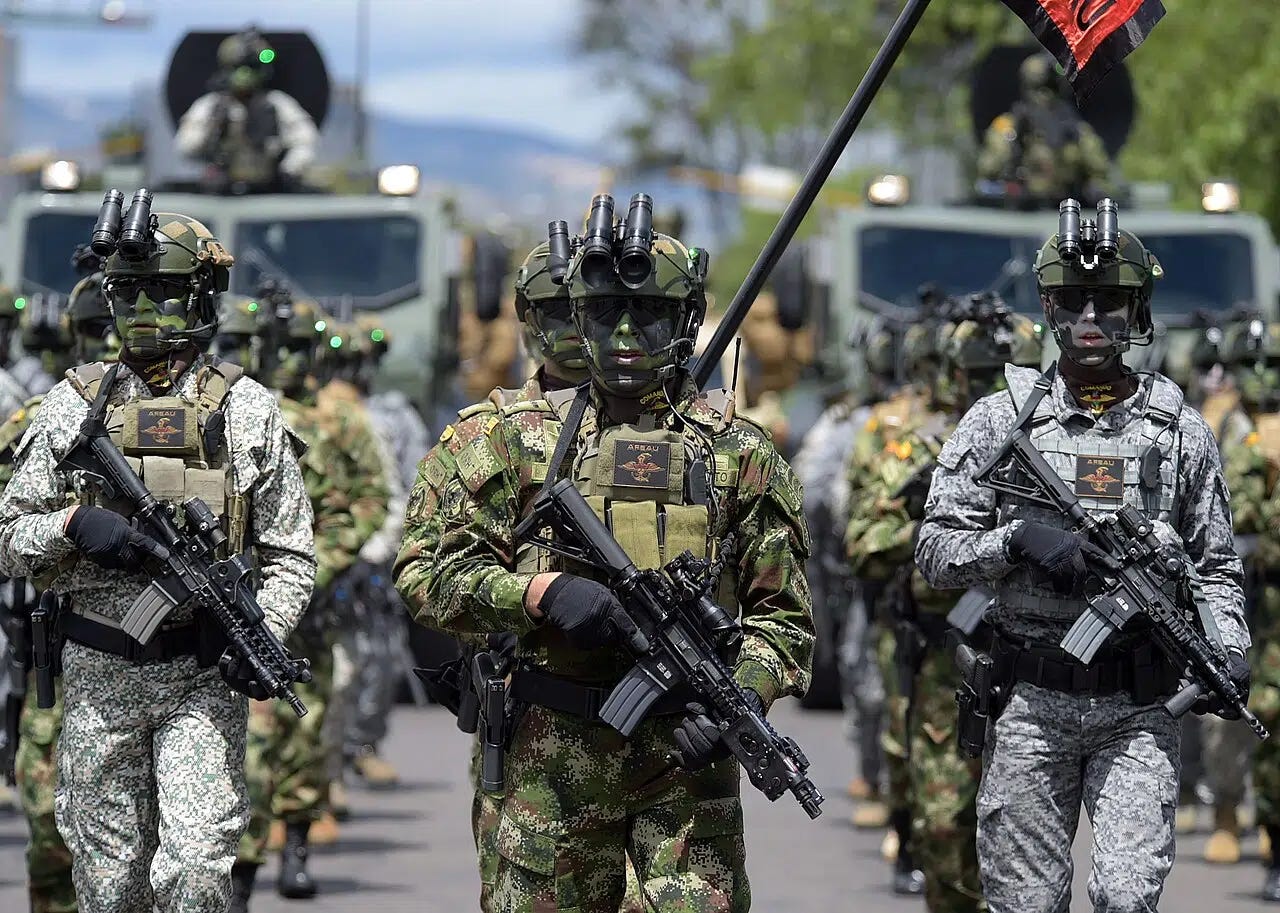
Far-right President-elect Abelardo de la Espriella assumes office in Bogota on Friday, August 7, after winning elections on a razor-thin margin. He brings with him promises to wield “iron fist” policies against non-state armed groups (NSAGs) and organized criminal structures in the country.
He has also promised to dismantle ongoing peace talks initiated by outgoing leftist President Gustavo Petro, including groups that are currently disarming. De la Espriella made scores of hardline promises on the campaign trail, many of which he will likely not be able to achieve with a minority coalition government in the legislature, such as withdrawing Colombia from the United Nations.
On security issues, however, Colombia’s constitution grants the President broad unilateral powers. De la Espriella has promised to “end” armed groups within a month, an extremely unlikely goal.
Despite claims from right-wing parties that Petro has gone easy on armed groups, Colombia’s military has been fully deployed against NSAGs in the country for the last two years.
As conflict expert Thomas Garrison reported for PWS in June, Colombia has ongoing and large military operations against FARC dissident group Estado Mayor Central (EMC), the National Liberation Army (ELN), and EMC splinter-group EMBF.
Colombia’s security forces are “already operating on all cylinders,” and “stretched to their limit,” according to the International Crisis Group. It isn’t clear how deployments can be increased without increasing the numbers of security forces themselves — hardly a goal that can be achieved in his first month in office.
Nonetheless, there are strategic changes that de La Espriella can impose to chart a more aggressive course. As part of those plans, the President-elect has promised to implement a “Plan Patriota remixed”, an allusion to highly aggressive US-backed military operations against armed groups under then-President Álvaro Uribe in 2003.
Uribe’s allies to this day hail Plan Patriota as a great success that forced the FARC to the negotiating table in 2016.
Critics, however, point to rampant human and civil rights violations, including working with paramilitary forces to kill thousands of civilians and frame them as guerrilla fighters to increase casualty counts.
The US, however, is pushing Latin America towards increased military spending and Bukele-style crackdowns on organized crime, and de la Espriella plans to comply.
What was Plan Patriota and how will Abelardo’s version be ‘remixed’?
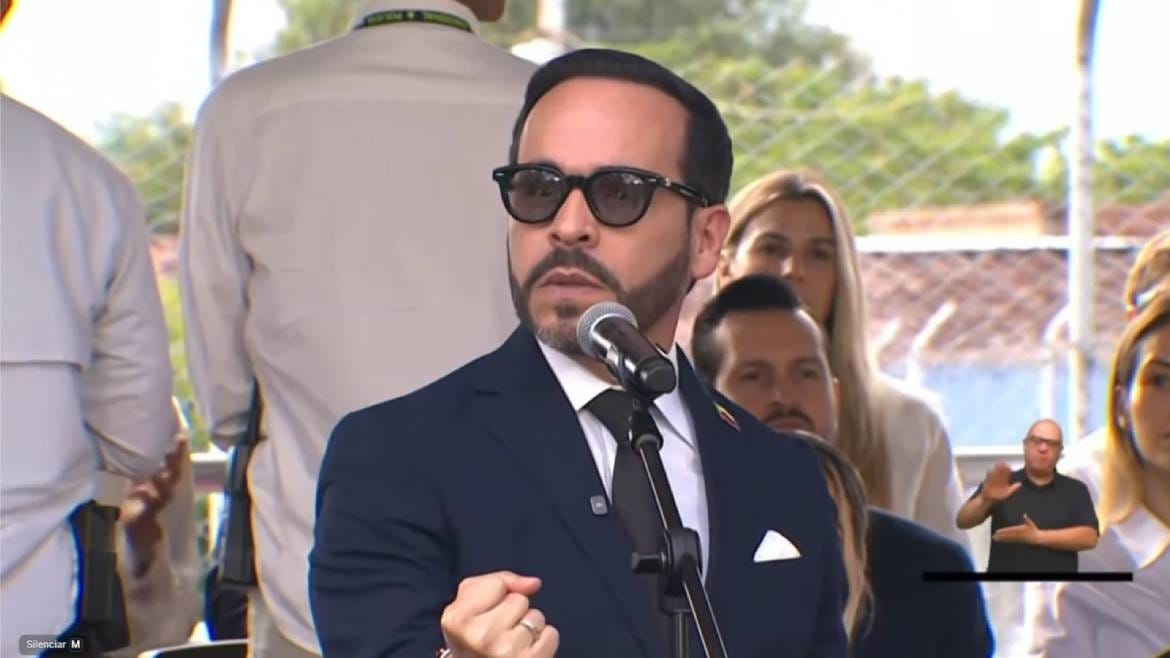
Plan Patriota involved aerial bombardments, large-scale military deployments in FARC-controlled areas, and aggressive intelligence gathering against FARC guerrillas at the height of Colombia’s civil war.
Although paramilitary groups were not officially part of Plan Patriota, they cooperated closely with regular military forces during the operation, functioning as spies, informants, and death squads — ostensibly killing alleged guerrillas, but just as often murdering leftists in general, as well as non-politically involved civilians.
The operation, which continued until 2010, weakened the FARC considerably, but at a great price: gross human rights violations including massacres, torture, and using sexual violence against civilians as a weapon of war.
Paramilitary structures were also greatly empowered across the country, sowing the seeds of groups that still exist today, such as the Ejercito Gaitanista Colombiano (EGC) — often referred to in Western media as ‘the Clan del Golfo.’
The full extent of the atrocities committed by both sides of the war would not become clear until Colombia launched its Truth Commission in 2017. (De la Espriella wants to disband the Truth Commission as well as the Colombian Peace Court, which prosecutes the worst offenders of the civil war.)
Any new version of Plan Patriota would look very different. Colombia is not the same country it was in the early 2000’s. Modern armed groups are not interested in clashing with state forces on the battlefield. Most are not interested in overthrowing the state at all, and certainly not via military victory.
Technology has also advanced considerably. Drone warfare is a dangerous new weapon in the arsenal of NSAGs who wage asymmetrical attacks on state forces as well as one another. Digital surveillance and satellite optics also mean that unlike the FARC, which often relied upon jungle canopies to hide large training and logistics camps, modern NSAGs instead blend into civil society in the communities where they operate.
They do not wear uniforms to distinguish themselves and avoid direct confrontations with the military, which means there are no large targets to bomb, nor columns of marching fighters for the state to confront.
Modern NSAGs are far more flexible, transnational, and relatively decentralized in their operations compared to FARC at the height of the civil war.
De la Espriella’s security program is more likely to look like Daniel Noboa’s policies in Ecuador than the 2002 Plan Patriota. It will likely include US cooperation on target-finding, naval cooperation on drug trafficking, and joint US-Colombia operations within the country.
Most of those dynamics already exist. Despite a rocky relationship with Washington, D.C, Petro continued to cooperate with the US on intelligence-sharing and anti-narcotics operations.
Critics of de la Espriella, however, fear that logistics won’t be the only similarity to Ecuadorian-US operations, which have resulted in the murder of civilians by security forces, torture, arbitrary detentions, and bombings of civilian infrastructure.
One factor that may keep de la Espriella somewhat in check is a lack of a clear mandate. He won elections by less than 1%, and has already clashed with more established right-wing political parties, who will not be forming part of his coalition in the legislature.
De la Espriella signals he will follow Washington’s lead
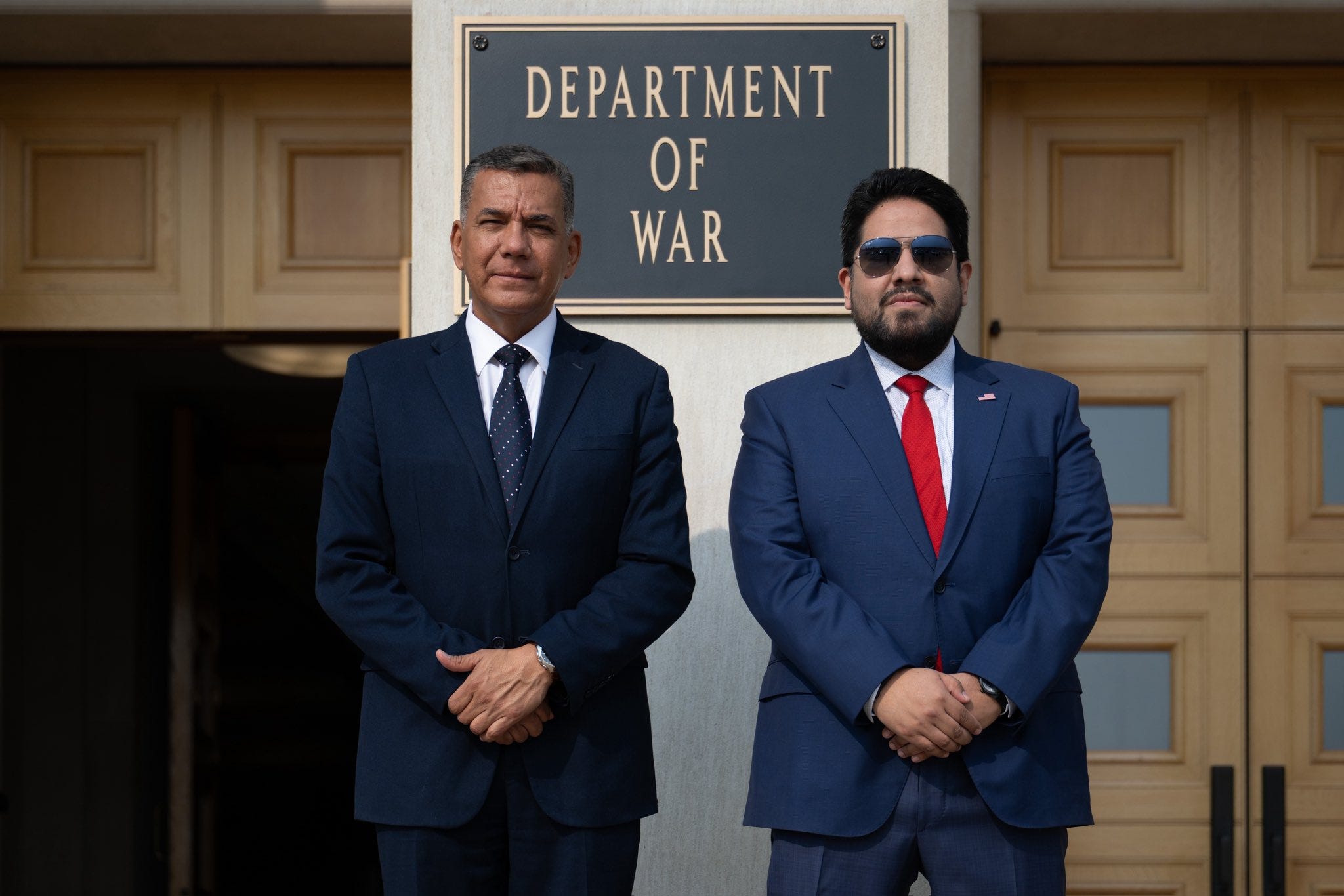
On a recent trip to the U.S, de la Espriella’s vice-president, José Manuel Restrepo, met with US Deputy Assistant Secretary of War for the Americas, Joseph M. Humire, who spoke of investment by US companies in hydrocarbon and energy sectors as well as cooperation on security and migration issues.
“Colombia is historically one of the U.S. strongest security and defense partners,” he wrote on X on July 21. “Under the leadership of incoming President Abelardo De La Espriella, we plan to take this partnership to new levels with Plan Patriot 2.0.”
Before Humire joined the War Department, he worked as an anti-migration lobbyist propagating conspiracy theories that cartels have “weaponized” migrants as part of “asymmetrical warfare” against the U.S.
He falsely testified before the House Foreign Affairs Committee in February that Venezuelan gang Tren de Aragua had “opened” the Darien Gap to migrants during the Biden administration as part of a Venezuelan plan to destabilize the US.
De la Espriella has already signalled that he looks forward to closer cooperation with the administration of US President Donald Trump and will largely follow the US lead on regional issues. Trump has made migration a key facet of his domestic and foreign policy.
The ultra-right Colombian president-elect has also promised to “secure” the country’s borders. Migrants “who are here illegally, or committing crimes will be deported to their countries of origin without delay,” he said in a press conference on July 13.
He has agreed, however, to keep commercial and migratory pathways open on the Venezuelan border. Petro re-initiated diplomatic and commercial ties with Venezuela in 2022.
De la Espriella has not criticized Chavista governments as heavily as many other right-wing politicians in the country, and provided legal representation for Maduro loyalist Alex Saab, who has been extradited for a second time to the US to face money laundering and corruption charges.
Aggressive military strategies have failed in the past
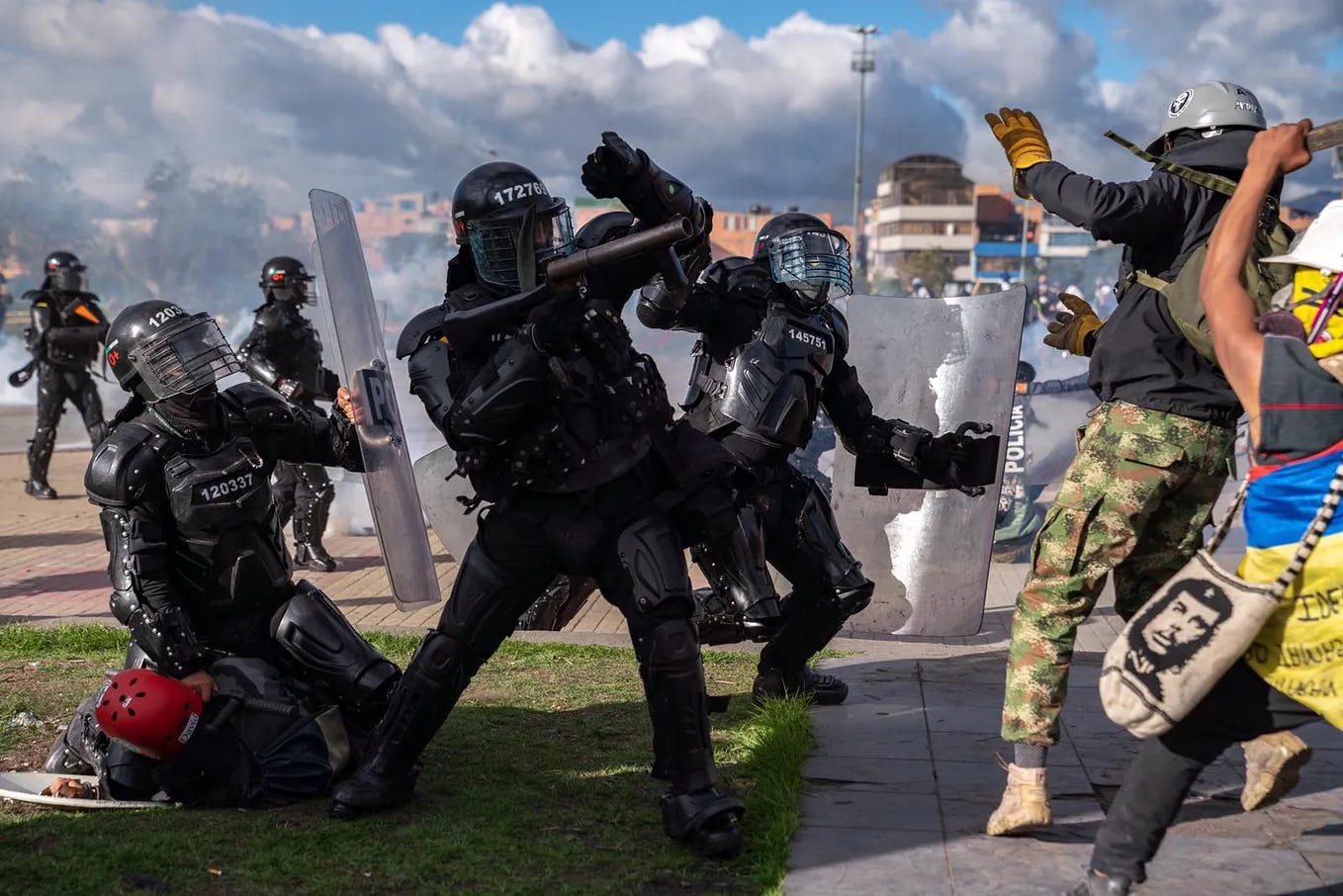
The nature of conflict has changed drastically in Colombia since the civil war, and presidents have tried aggressive military tactics against criminal organizations and NSAGs before.
Former President Iván Duque failed to slow the rapid growth of either during his time in office from 2018 to 2022.
The Colombian state failed to fulfill its promises to invest in legitimate economies and develop regions long ignored by Bogotá. Regions that had previously been governed by the FARC became power vacuums that were quickly filled by other criminal organizations and NSAGs.
Duque left office the least popular president in the country’s history since records have been kept, in part because of his security policy. Bombings on rebel camps that killed minors created significant public controversy. When Petro turned to similar strategies, the military inadvertently killed children as well.
Armed groups have continued to grow under Petro despite his employment of increasingly aggressive military strategies. De la Espriella has not offered details about his plans, and it is unclear what he could do that Duque and Petro did not, or why the results would be any different for his administration when similar tactics have failed before.
Trump, however, has gained a new ally in the region. The US President has often shown that projection of US power is an end in and of itself, and de la Espriella is likely to allow Trump to do exactly that.
You can also donate a one-time gift via “Buy Me a Coffee”. It only takes a few moments, and you can do so here.
And if you can’t do any of that, please do help us by sharing the piece! We don’t have billionaire PR teams either.
Hasta pronto, piratas!

Great work on this Joshua!
I'll add that many of the current FARC commanders de la Espriella will be facing both survived Plan Patriota and either were not forced to the negotiating table or took up arms again the fight Duque's government. Because of that, I'm deeply skeptical a new Plan Patriota would even be able to significantly weaken the FARC remnant groups active in the country today.
It's also worth pointing out that, in the long run, Noboa's hardline security policies in Ecuador actually made things worse. Homicide rates in Ecuador hit an all-time high in 2025! In Colombia, there are armed groups like Comuneros del Sur and the CNEB that seem to have shown some surface-level restraint under Petro so as not to jeoprodise peace negotiations with his government. I doubt they will have any incentive do to so under the new de la Espriella administration.
In short, my expectation is not only that de la Espriella's security policies will fail, but that, like Duque and Noboa, he will make Colombia's already deteriorating security situation even worse.
Yes, agreed, it’s going to be awful. I listened to a radio programme on BBC Radio 4 a couple of days ago about an English chap who spent 9 years in jails in Ecuador for trying to smuggle cocaine impregnated into canvas tents to the UK. His stories of the warlike conditions inside those places really brings home the message that the Ecuadoreans cannot really cope with the drugs trade gangs either.