

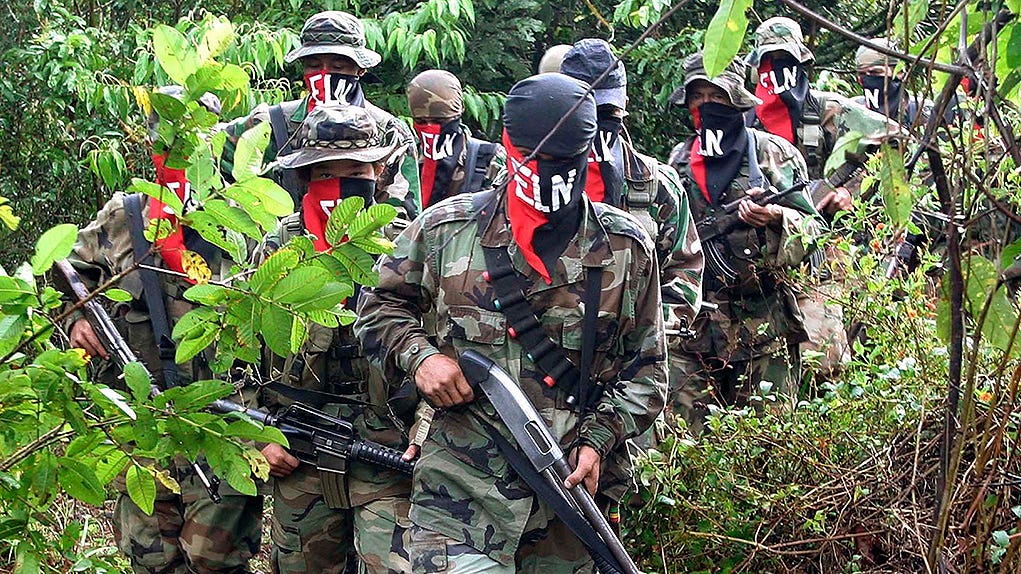
Colombia’s largest remaining rebel group, the National Liberation Army (ELN), on Friday announced a “general armed strike” in response to US President Donald Trump’s statements threatening the country in statements to the media.
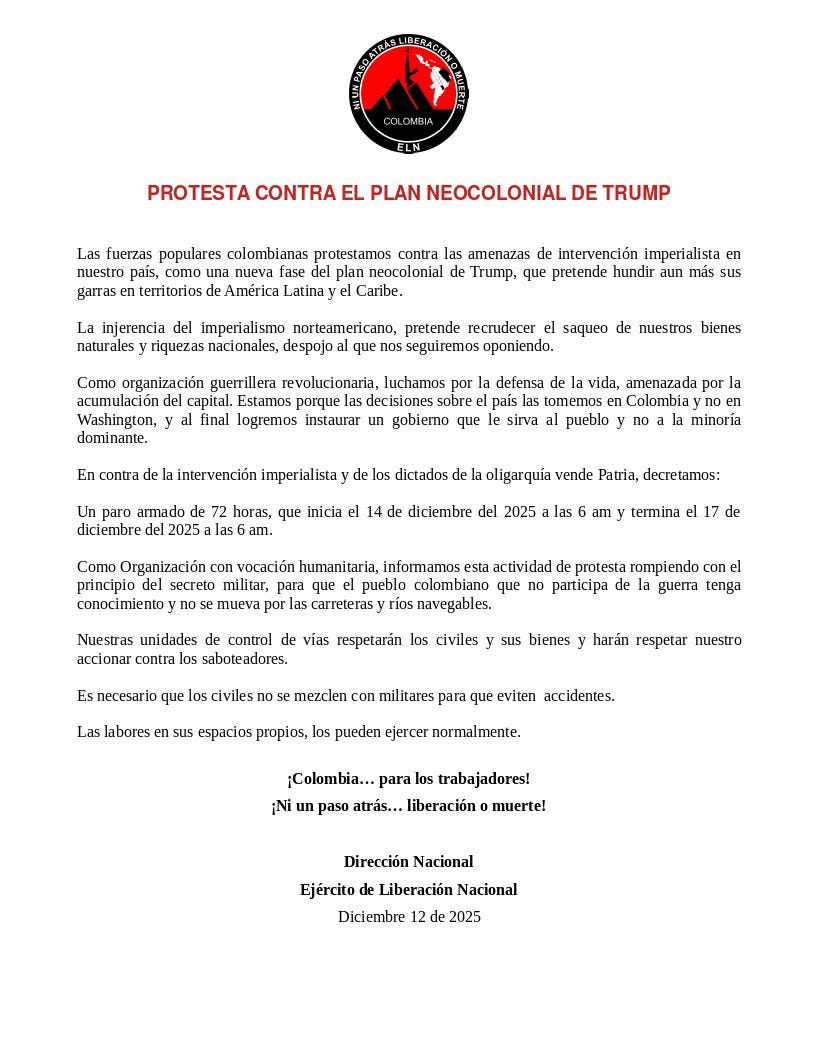
According to a statement on Friday, the armed action will be carried out between the 14th and 17th of December.
Calling threats of US intervention in Colombia “the agenda of dictators and those who would sell out their own fatherland,” the ELN claims Trump “intends to sack our country of natural resources.”
The group, which has long espoused Marxist ideologies, calls for a “popular uprising” against the US across Latin America, and plans to enforce an “armed strike on a national level” within Colombia.
There is a lot of context to unpack here. (Have we ever mentioned that we love context?)
Let’s start with some basics before getting into what this means in practice! ELN is the second-largest non-state armed actor in Colombia (behind AGC, which has origins in the paramilitary forces that fought on the side of the state during the civil war) and controls vast swathes of territory. For those of you who aren’t familiar with Colombian armed groups’ dynamics (because I know a lot of our readers are), let’s explain what that means exactly.
When we say “ELN controls vast swathes of the country”, we don’t mean the way a gang might control a street corner in, say, Baltimore in the US. We mean they control it. They are the hegemonic power in their strongholds, not the state.
These regions include southern Chocó, on the Pacific coast, and large parts of Arauca and Catatumbo on the Venezuelan border.
In many ways, within these regions, they perform the services states usually do: they enforce a monopoly on violence, settle disputes, provide security, and act as “police” in the regions they control.
You will not see Colombian security forces in ELN strongholds, unlike US police in our example from Baltimore.
Many more regions where ELN maintains a presence are usually described as “contested”. In these places, like Northern Cauca, Antioquia, parts of Arauca, Meta, Southern Bolivar, and other regions, ELN is attempting to consolidate complete control, but has not achieved hegemony.
In some of these places, the Colombian state still exerts effective control. In other regions, that control is disputed by other armed non-state actors, such as FARC splinter groups, AGC, or dozens of smaller criminal groups, some of whom do not have political motives.
In the past, the ELN has conducted “armed strikes” in regions both contested and firmly controlled as displays of power. Despite the name, these actions are better understood as lockdowns than labor actions.
When an armed strike is announced, ELN demands that stores shutter, transport trucks cease activity, and all economic activity cease. They use violence to enforce this ultimatum. Anyone who violates the lockdown may be punished with a “fine” or, in extreme cases, be killed.
Traffic on major highways is often prohibited as well, enforced by random checkpoints of ELN fighters. Historically, these actions also target Colombian security forces, who generally avoid confrontation with the ELN due to fear of being attacked.
In past lockdowns, the ELN has enforced temporary suspensions of all economic activity in broad swaths of the country, even in areas where they normally have very little actual territorial control.
Usually, they also carry out bombings against police stations or ambushes on security forces that violate their dictums by conducting patrols.

In their statement on Friday announcing the action, they write that “civilians will be respected,” as long as they are not “mixing with military members,” in which case “accidents” may be excused.
In the past, FARC rebel groups have generally allowed ELN actions to proceed, even in regions where the groups are in conflict. AGC, however, often intentionally tries to violate the lockdowns: a tactic that has at times resulted in fighting between the two groups.
The scale of the coming 72-hour armed action is yet to be seen, but it could potentially affect hundreds of thousands of Colombians.
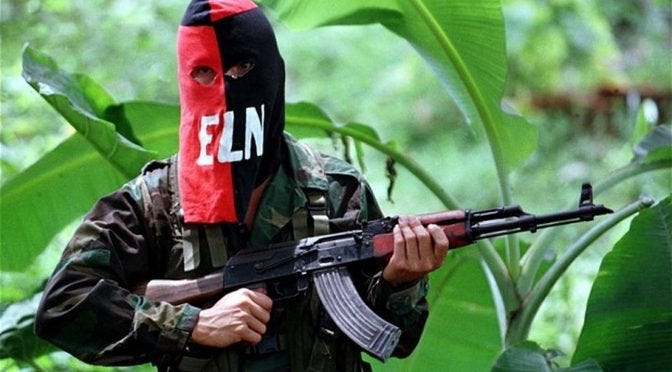
The ELN has grown exponentially in both territories and numbers since 2017, when rebel group the FARC signed a peace deal with the Colombian government and disarmed en masse.
Although public statements by Colombian intelligence are often untrustworthy, it is generally accepted that the ELN has more fighters in its ranks currently than at any point in its history.
This armed strike will be viewed by researchers of conflict in Colombia, as well as the state, as a barometer of how much power the ELN currently has. That is exactly what the ELN intends.
They sign their Friday missive with the phrase “Colombia for the workers. Not one step back. Freedom or death!”
You can also donate a one-time gift via “Buy Me a Coffee”. It only takes a few moments, and you can do so here.
And if you can’t do any of that, please do help us by sharing the piece! We don’t have billionaire PR teams either.
Hasta pronto, piratas

!