

This week’s feature is by Colombian journalist Nicolás Zuluaga
Ecuador’s President Daniel Noboa this week hiked tariffs on Colombian imports to 100%. It is the latest escalation in an ongoing and bitter trade war with neighbor Colombia.
But as gangs fueled by cocaine from Colombia spread inland into previously safe areas of Ecuador, and homicides shatter already high records, many see the border dispute as less about retaliation over a perceived lack of security efforts by Colombia and more about Noboa deflecting from his failing “iron fist” policies.
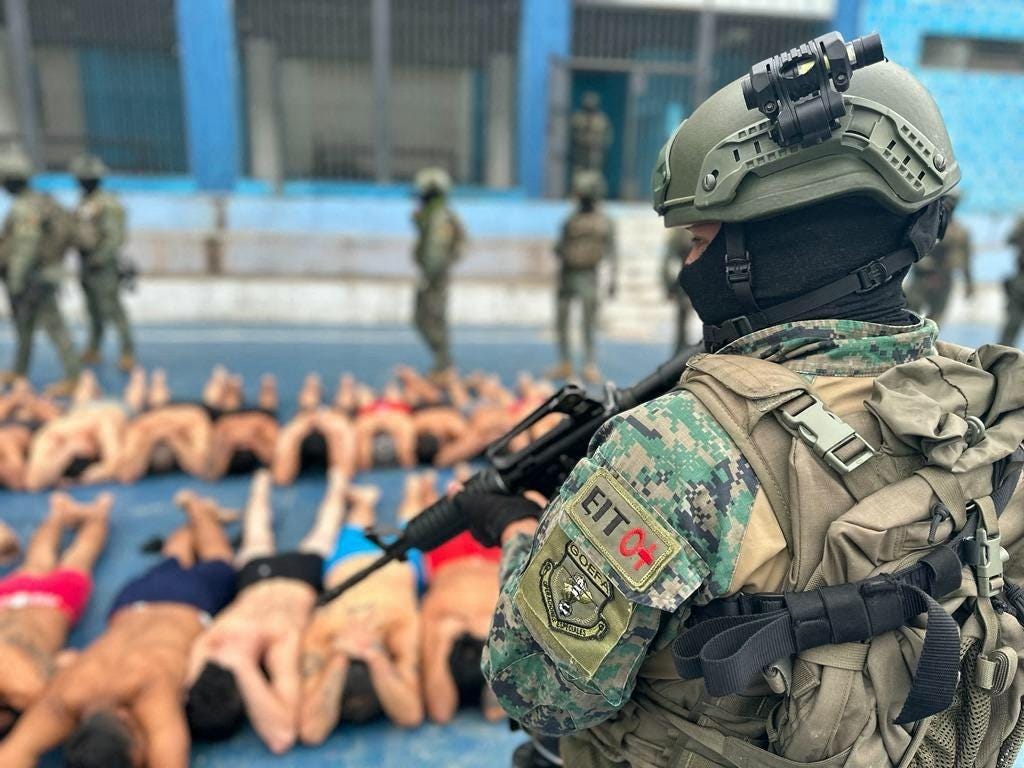
Noboa’s aggressive policies include military raids, U.S.-backed bombings, crackdowns on civil society, and labelling cartels as terrorist organizations. Naboa has loudly and publicly vowed to crush organized crime. Instead, reports show violence spreading into Ecuador’s interior, including into areas once spared from the coastal bloodshed, far from infamous port-cities like Guayaquil.
In recent years, cocaine from Colombia and Peru —the world’s top producers— has flooded across Ecuador’s borders and towards its port, which has become a key hub in international smuggling. The dynamic caused a surge in criminality in Ecuador, which was once among the safest countries in the region, but now holds one of the highest homicide rates in Latin America.
Noboa blames the rise in violence on Colombia’s leftist President Gustavo Petro for “lax borders” that dump “narco-terrorists” on Ecuador.
Noboa claims Petro has “handed the border over to the mafia.”
In a recent interview with Semana, an ultra-right-wing tabloid in Colombia, Noboa claimed that Petro maintains communication with criminal leaders in Ecuador.
Noboa accused Petro of indirect connections with accused Ecuadorian narco Adolfo Macías, alias “Fito.” Naboa claims that Petro communicates with members of the Ecuadorian opposition, who in turn pass on those communications to Fico.
He offered no proof for his accusations.
Petro’s leftist party, Pacto Histórico, has in turn accused Noboa of making false claims in an attempt to interfere in Colombian presidential elections, which begin next month.

In recent months, Naboa has ratcheted up more than just rhetoric. He is conducting military actions in the borderlands in cooperation with US military forces as part of “Operation Total Extermination,” that have at times veered into Colombian territory.
Petro, for his part, however, is doing little to calm the situation. Last week, the Colombian president labeled the former vice-president Jorge Glas, who is currently jailed by Ecuador, a “political prisoner,” and demanded his release.
Glas is a close ally of former President Rafael Correa, who fled the country after being formally charged with corruption. Glas is currently serving out a jail sentence after a corruption conviction of his own.
The comments sparked Naboa’s latest tariff increase last week.
President Petro promptly responded in comments, saying that the Colombian government will respond according to the “principles of reciprocity” and announced similar Colombian tariffs on Ecuadorian goods.
Many experts, however, believe Naboa is trying to reframe Ecuador’s security challenges in external terms, pointing to actors beyond his borders even as he strengthens ties with Washington, including his recent alignment with President Trump’s “Shield of the Americas” initiative.

Sebastián Hurtado, founder and president of Profitas, a leading political risk consultancy based in Quito, calls Noboa’s rhetoric a gamble. Noboa is “weaponizing trade and tying it to security policy,” Hurtado told PWS. Noboa “argues that Colombian inaction was bleeding Ecuador dry, forcing Quito to bear the financial burden of a war against organized crime that originates next door.”
Noboa has gone all in on promises to restore security, but as violence keeps rising in Ecuador, his efforts are beginning to look increasingly shaky.
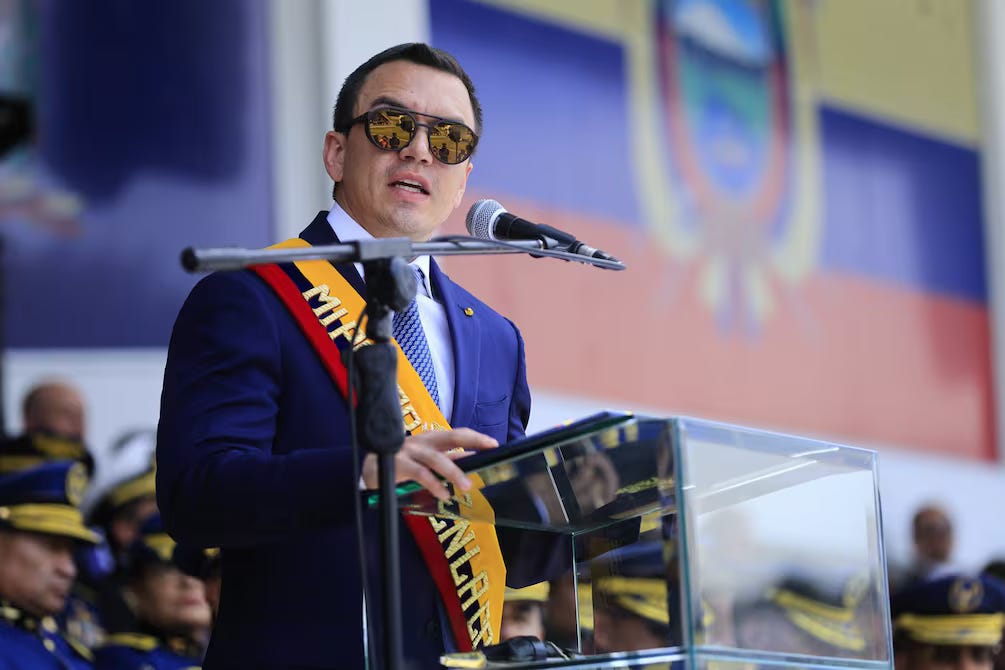
Petro’s focus on negotiating and communicating with armed groups in return for their eventual disarmament presents Noboa with a useful foil for his own more draconian security policies. Naboa has called Colombia’s “Total Peace” strategy “soft,” claiming it has allowed criminal networks and cocaine flows to expand across the region.
Hurtado says that both Noboa and Petro are leveraging the border crisis to shift blame and stir nationalist support as their domestic positions weaken. Noboa isn’t only on his back heels over setbacks on security, but is also fresh off a failed campaign over a voter referendum on allowing US military bases in the country and permanent increased police powers.
Noboa also faces mounting criticism of human and civil rights violations by military and police as part of his crackdowns — and a recent conviction of 11 Ecuadorian soldiers for kidnapping and murdering a group of Afro-Ecuadorian children last year in a case that outraged the country.
Petro, meanwhile, is carrying his party towards elections amidst mounting governance challenges, including rising conflict in rural regions of Colombia.

It’s not the first time Noboa has tried to shift blame for Ecuador’s security woes to foreign entities. In March, Noboa claimed that Hamas and Hezbollah have ties to Ecuadorian gangs and maintain an active presence in the country. He has also repeatedly blamed “Tren de Aragua” for rises in homicide in the country. There is no evidence for either claim.
As Ecuador’s homicide count climbs past 1,200 this year, a 200% surge since Noboa took office, the effectiveness of his “mano dura” security strategy is being questioned even by his supporters.
Human rights groups have also reported increased allegations of abuses tied to expanded military and police operations — including killings, arbitrary detentions, and forced disappearances.
Meanwhile, the tighter border controls and tariffs along the Ecuador-Colombia frontier have had unintended consequences. Merchant groups say informal and illicit cross-border trade has grown as businesses and criminal networks seek to avoid paying tariffs by crossing the border informally. The increased traffic is presenting opportunities for criminal groups to camouflage their own smuggling of cocaine, cash, and weapons across an already porous border.
Noboa’s tariff escalation is a gambit meant to distract from failing policies at home but deepening tensions with Colombia, which has often cooperated on security issues with Ecuador, risks exacerbating the security crisis. As coordinated actions on trafficking routes and organized crime in the regions cease, both countries are reinforcing the insecurity that sparked the dispute in the first place.
You can also donate a one-time gift via “Buy Me a Coffee”. It only takes a few moments, and you can do so here.
And if you can’t do any of that, please do help us by sharing the piece! We don’t have billionaire PR teams either.
Hasta pronto, piratas!


Let's say Noboa is right that the borders are a sieve, and the way to beat the cartels is through enforcement at the borders. Then, he also has to share the blame for the laxed borders, since he and his admin control the Ecuadorian side of the borders and yet the drug gangs still find a way into Ecuador. Thus he should focus more on his own admin than those of other administrations, and ask himself why his border guards let so many cartel members through? But I guess that would lead to a realization that the guards and the police have a corruption issue. And that no matter how many guards one employees there is so much border it is impossible to police, and it would be more frugal to figure out how to dissuade individuals from joining the gangs.
But like most right wingers he doesn't want to help people directly. In that case, his admin could look into ways of detecting drugs at the ports to force the gangs to other ports (hoping they aren't in Ecuador) and making the whole endeavor less effective. That is more expensive than just welfare and as I said it sort of just moves the gangs to other ports (sort of like in the Netherlands the criminal gangs no longer use Rotterdam but have moved to smaller ports such as Middelburg in Netherlands or ports in Spain) but it does make them less effective.