

This is an installment of the “Ship’s Log” series, more personal entries or deep analysis on the beats we cover for paid subscribers.
If you haven’t signed up for a paid subscription, we urge you to consider doing so. We have plans that start at just $5/month, and the resources help us continue bringing you the stories that most big media companies miss. This story will become available to all readers in 5 days.
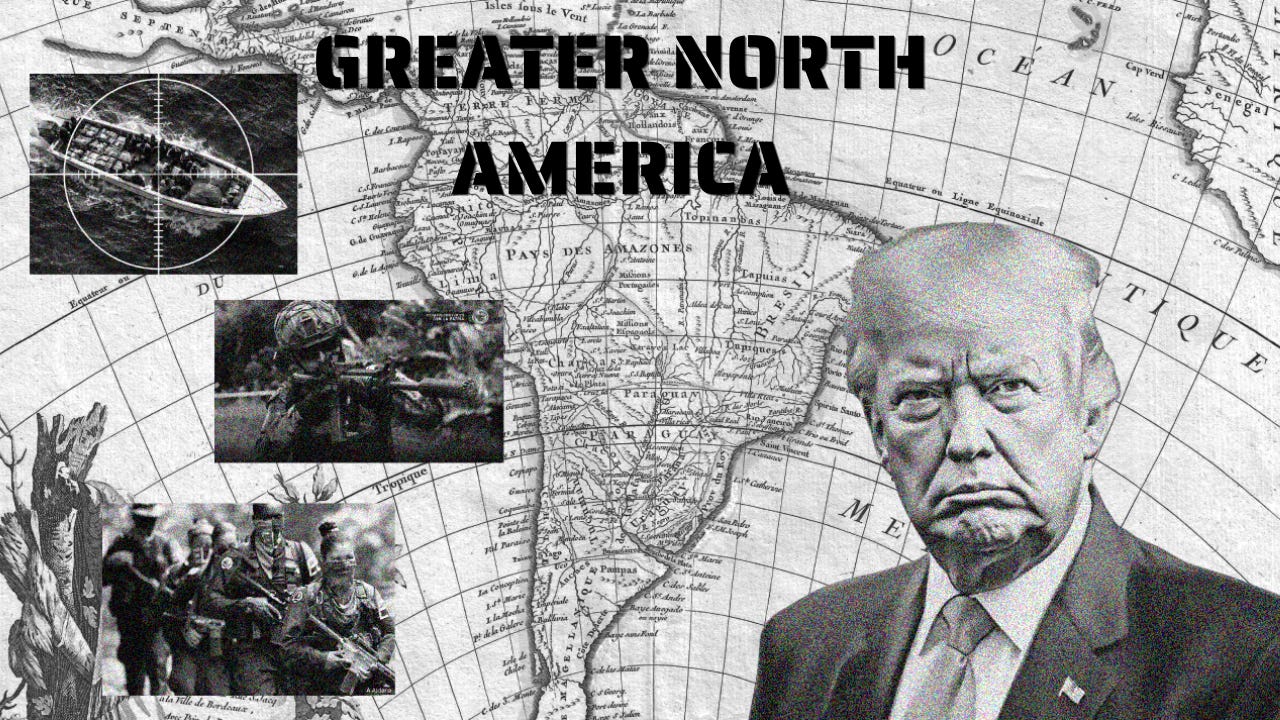
The administration of Donald Trump has rolled the “Wars” on terrorism, drugs, and migration into one. And the US using the resulting “omniwar” as a justification for a massive increase in US power projection across the Western Hemisphere.
The North American country is imposing a level of aggressiveness and direct intervention in the region not seen since the height of the Cold War. Through military strikes, economic threats, naval blockades, drone strikes, election interference, and favors to Latin American leaders who subordinate themselves to US interests, Trump has employed strongman tactics to get what he wants in Latin America.
The tactics have not achieved a reduction in drug flows to the US, increased security, or a reduction in power of the groups the US considers “terrorists,” but members of the administration have made it increasingly clear that those were never the underlying motives for US actions.
Trump spokespeople have adopted the portmanteau “Donroe Doctrine,” to describe US plans to “reassert and enforce the Monroe Doctrine to restore American preeminence in the Western Hemisphere,” according to the 2025 US National Security Strategy.
The nickname is a variation of the Monroe Doctrine —a legal argument that was invoked to justify US assassinations, invasions, blockades, the financing of death squads, and the installation of dictatorships across the Americas, primarily but not exclusively, in the 20th century.
The Monroe Doctrine led to egregious human rights violations across the Americas and a history of covert as well as open US interference and intervention in the region that most people today strongly reject.
However, it did largely achieve the goals of its proponents. US expansionism created an effective “Empire” in the vast majority of Latin America. States in the region either became clients or subordinates, or they risked becoming active enemies of the US.
Under Trump, however, US actions have been chaotic, self-contradicting, and at times even counterproductive (even from the point of view of those who espouse a return to some of the darkest days of Latin American history)
Under Trump, however, US actions have been chaotic, self-contradicting, and at times even counterproductive (even from the point of view of those who espouse a return to some of the darkest days of Latin American history)
Military actions have yielded mixed results and have failed to achieve either increases in security in the regions where the US military is operating or the flow of drugs.
The invasion of Venezuela and capture of then-President Nicolas Maduro was widely viewed as a stunning tactical victory by hawkish members of the Trump administration. Less trumpeted by his advisors and cabinet members, however, are security losses in Ecuador, the adpatation of drug flows through commercial ports, and increasing conflict in countries where non-state armed actors and organized crime networks have sophisticated income and logistical operations.
Secretary of War, Pete Hegseth, in a March press conference with right-wing Latin American leaders as part of a “Counter Cartel Conference”, underlined that US efforts are not motivated by drug flows, security, or migration at all, but rather establishing US dominance in the region.
In comments to the press, Hegseth claimed the US has a “new strategic map” of LATAM, which he described as a “greater North America.” Administration officials have since made very clear, in public comments, that the US intends to assert American dominance over what it considers its half of the planet.
Trump’s “Mr Bean Security Strategy”
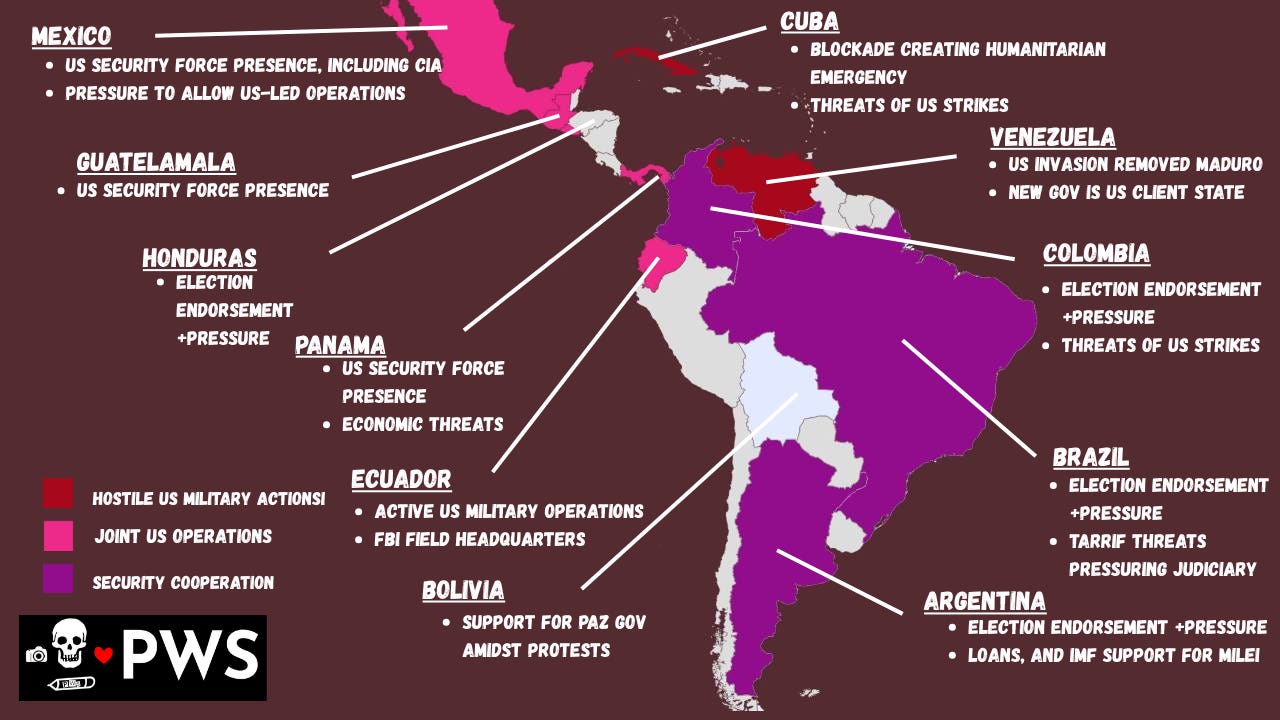
To further those efforts, the US has tapped allies that endorse strongman tactics (and committed human rights violations), such as Nayib Bukele in El Salvador and Daniel Noboa in Ecuador, as well as installed President Delcy Rodríguez in Venezuela, who has assumed a submissive stance towards US interests after the removal of then-President Nicolas Maduro in a US attack on the country in January.
The US has used tariff threats to push Mexican President Claudia Sheinbaum into cooperating with US military inside the country, even deploying the Central Intelligence Agency (CIA) to aid in operations, and the assassinations of narcos in the country.
Dozens of extrajudicial drone strikes in the Caribbean and Pacific Oceans have killed more than 200 people, and have become largely normalized in news cycles. Officials claim the boats were transporting drugs, but have offered no proof, and in at least two cases, the vessels struck later proved to be carrying only local fishermen.
Members of the administration have also admitted that some of those killed may have been migrants, or even victims of human trafficking.
As part of assembling a dream team of LATAM lackeys, in March, Trump brought together 13 right-wing heads of state from the region to form what he is calling the “Shield of the Americas Coalition.”
Those attending included the presidents of Argentina, Bolivia, Chile, Costa Rica, Dominican Republic, Ecuador, El Salvador, Honduras, Panama and Paraguay, as well as the prime ministers of Guyana, Trinidad and Tobago and Jamaica.
The alliance was formed with the goal of improving security and combatting cartels. “The heart of our agreement,’ said President Trump at the time, “is a commitment to using lethal military force to destroy the sinister cartels and terrorist networks.”
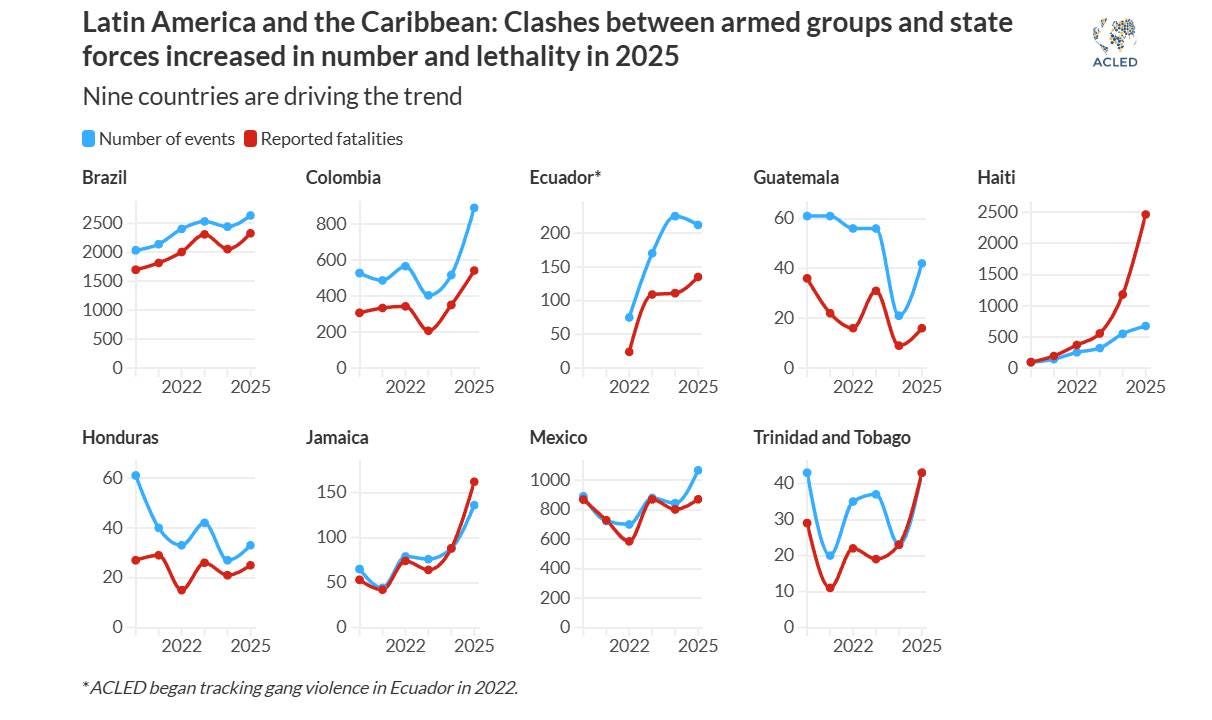
But if improving security or combating organized crime is the goal of Trump’s foreign policy in LATAM, those efforts have summarily failed. ACLED (the Armed Conflict Location & Event Data Project), a non-partisan think tank that studies conflict in the Americas, released a report in May that showed exactly how badly.
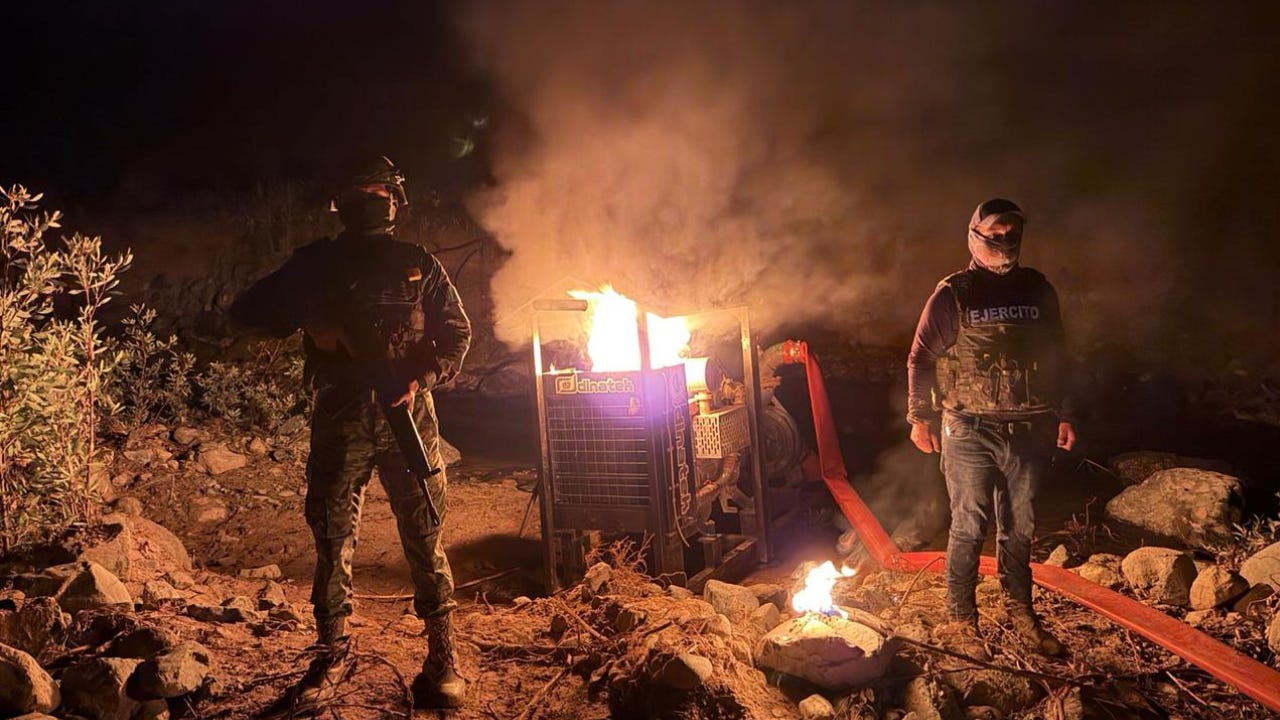
In Ecuador, where the US is conducting joint missions with the Ecuadorian military, crackdowns by security forces have resulted in the torture and killing of civilians and gross civil rights violations, but have failed to stem either the growth of armed groups or homicides.

Mexico has seen a drop in homicides over the last year, but ACLED suggests this isn’t the entire story, in part because groups may be hiding the bodies. Forced disappearances in the country have long been an endemic problem, and the number continues to grow.
In addition, the think tank suggests that non-state armed actors may be lowering their visibility and diversifying into new income streams, a practice that has included their infiltration of state security forces.
Meanwhile, deaths as a result of confrontations between organized crime groups and state security forces in the region are growing ever more common. Organized crime has not been weakened in the country. Cartels instead are adeptly adapting to new security conditions.
Boat strikes may have disrupted some small drug routes, but in every country between Ecuador and Mexico drug smuggling through official ports has increased, and new maritime routes have developed.
US security efforts under Trump increasingly resemble the improvised flailings of comic personality Mr Bean as he finds himself in ever more chaotic circumstances.
The strategy, or rather the random assortment of tactics, because it is certainly not a strategy in any security sense, only begins to seem rational when we realize that security improvements are not the true motive at all.

“Twitter Diplomacy” as blunt force object
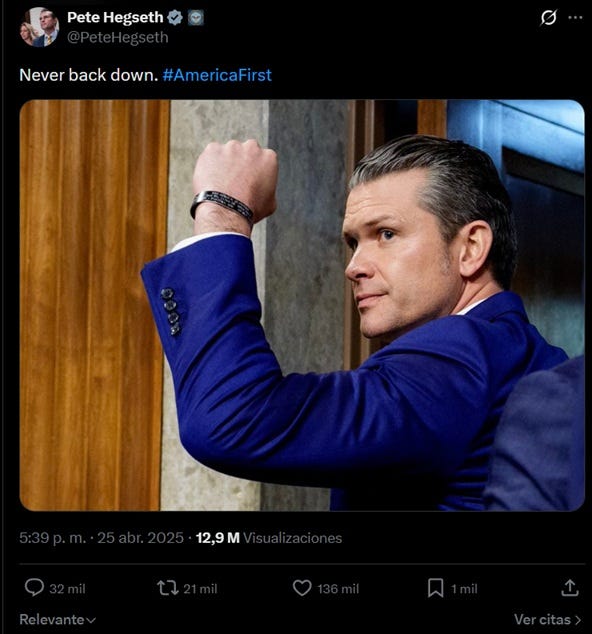
Since Trump came into office, his administration has shown disdain for traditional channels. Ambassadors not only aren’t often, they are often never even appointed. The American Foreign Service Association reports 115 out of 195 positions sitting vacant — an all-time high for the US.
Instead, Trump prefers to speak through strong statements on social media or through his cabinet. The statements often present the US in maximalist rhetoric and often contain threats to states that Trump is unhappy with.
Secretary of State Marco Rubio and Secretary of War Hegseth often issue threats via Twitter while Trump prefers the social media site he owns, Truth Social, but the effect is the same. Leaders in Latin America don’t receive ultimatums via ambassadors in private meetings where negotiation is possible, but rather from public statements, with the Trump team offering little opportunity for dialogue.
The administration has used public threats to impose itself in elections in Argentina, Brazil, Colombia, and Honduras: each time threatening sanctions (or in the case of Argentina, withholding loans) or a hostile relationship with Washington D.C if their preferred candidate did not win.
Trump also applied retaliatory tariffs on Brazil in an attempt to blackmail their judicial branch and defend his ally Jair Bolsonaro.
In each case, the motives of the US have been the same: the threats or bribes are attempts to install leaders who will be subordinate to US interests.
The lack of appointments is intentional. Trump holds disdain for traditional diplomacy, claiming their process has “strengthened US diplomacy and streamlined decision-making.”
Critics, however, say the social media approach to foreign relations has fundamentally damaged the US ability to understand the world, and is causing global instability.
Conclusion
Cuba, which has been a personal obsession of Marco Rubio for decades, is suffering a humanitarian disaster due to US naval blockades which have led to shortages of fuel and chronic power shortages.
In Colombia, the administration has endorsed an ultra-right wing firebrand with ties to paramilitary death squads who has promised to “disembowel” leftists who attempt to undermine his agenda and promised criminal investigations into current President Gustavo Petro.
Ecuador teeters ever-closer towards a dictatorship as President Daniel Noboa consolidates power via dismantling of the judiciary and “states of exception” modeled after Salvadoran President Nayib Bukele.
The US State Department has authorized Blackwater to carry out extrajudicial drone assassinations in Haiti, openly admitted to CIA-planned killings in Mexico, and threatened military strikes within Colombia.
The US strove for more than a century to become the hegemon in Latin America, and was willing to pay a heavy price in both blood and treasure to do so, but those were often the unspoken motives.
In public, US officials spoke of “strategic partnerships,” “fortifying democracy,”or “investments.” Trump has stripped away all veneer. He plans to force Latin America into subservience, using all tools at his disposal.
His efforts have often enlisted the private sector, promising a share of the loot in return for their political support, and enlisted the billionaires who control modern media to help him normalize it all.
Though none of these actions are completely novel in regards to US foreign policy in Latin America, the complete lack of pretense is.
For leaders in the region, the message could not be more clear. “Submit. Or become our enemies.”

Thank you, a fair assessment, I believe of the prospects for central and South America, very concerning.